
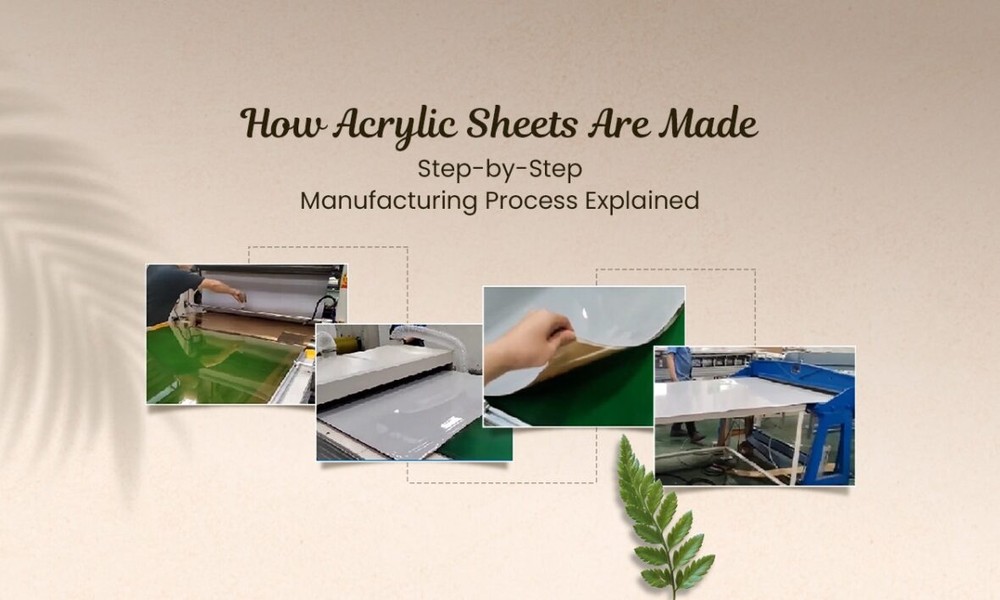
Acrylic is a well-liked material in architectural designs because of its lightweight nature, long-lasting properties, and shiny finish. Therefore, it can be used in multiple places like signage, furniture, and cabinets, and the quality, strength, and life of the acrylic will all depend on the quality of the acrylic sheet.
In order to understand the quality of an acrylic sheet, we must look first at how the acrylic sheets are created.
Raw Material Preparation
Acrylic sheets are manufactured from a substance known as polymethyl methacrylate (PMMA), which itself is classified as a clear polymer material. Polymethyl methacrylate (PMMA) is manufactured from liquid methyl methacrylate (MMA) that has been distilled to achieve an even and clean product of methyl methacrylate (MMA) before polymerisation takes place.
The quality of the raw materials will subsequently play a vital role in the appearance and durability of the finished acrylic sheet; therefore, only high-grade raw materials should be used to create acrylic sheets.
Polymerisation Process
Once the raw materials have been properly mixed together, the next part of the process involves converting the liquid methyl methacrylate (MMA) to a solid polymer through a process known as polymerisation. Polymerisation is simply the process whereby individual molecules combine together to create long-chain polymers as a result of the chemical reaction that occurs with the introduction of heat and pressure during polymerisation.
The final product of this process will be free of air pockets and will provide superior optical clarity as well as superior structural integrity.
Methods of Manufacturing
The manufacture of acrylic sheets can be performed in one of two ways, regardless of whether they are made by using the cast or extruded process:
Cast Acrylic
The cast acrylic process involves the pouring of liquid acrylic between two transparent glass surfaces that are separated by standoff (spacers). The cast acrylic is then subjected to heat and cooling until such time as it has turned from liquid into solid form.
Cast acrylic sheets will exhibit very high levels of optical clarity and superior surface finish compared to extruded acrylic sheets.
Extrusion
In the extrusion process, sheets of uniform thickness are created by forcing liquid acrylic through an opening (die). This method takes less time and is less costly than the casting process. Because of these advantages, extrusion is frequently used in the mass production of large quantities of acrylic sheets.
Both methods of creating acrylic sheets will yield a high-quality final product; however, premium applications (e.g. acrylic sheet for the kitchen) will most likely use cast sheets.
Cooling and Hardening
After being shaped, the sheets must be cooled in a controlled manner to prevent internal stresses and warpage. Gradual cooling also provides dimensional stability and surface smoothness.
Properly hardening the sheet will provide improved protection against cracking and greater durability.
Cutting and Finishing
After hardening, the acrylic sheets are cut to standard sizes with polished or smoothed edges, depending on the intended usage. To prevent damage from transportation and installation, the sheets will have protective films on both sides.
For acrylics that will be used in high-gloss applications (e.g. kitchen cabinets), additional polishing may occur to create an even higher-quality finished product.
Quality Inspection
Before acrylic sheets are distributed to manufacturers or retailers, they must pass quality inspections. These inspections shall include tests for consistency of thickness, clarity of surface, uniformity of colour, and resistance to impact. Sheets that successfully pass inspection are packaged and shipped.
Strict quality inspection of all acrylic products ensures that products used in kitchens and on furniture will perform for many years.
Why Quality in Manufacturing is Important
The overall performance of a sheet of acrylic is greatly influenced by the manufacturing method used to produce that sheet. Proper polymerisation, uniform thickness of the sheet, and controlled cooling will provide moisture resistance, heat resistance, and resistance to daily wear.
For applications such as kitchen cabinets, where surfaces will frequently be cleaned and exposed to humidity, precise manufacturing will greatly impact the performance and aesthetics of the product.
Conclusion
The manufacturing of an acrylic sheet requires proper chemical processing, controlled production of the sheets, precise cooling, and complete quality inspections. The quality and clarity, strength, and consistency of each sheet are achieved through each of the processes described, whether cast or extruded.
Understanding the step-by-step processes involved in manufacturing acrylic sheets for kitchen applications helps explain why acrylic sheets continue to be a popular choice for modern interiors, which need gloss, durability, and long-lasting visual appeal.