
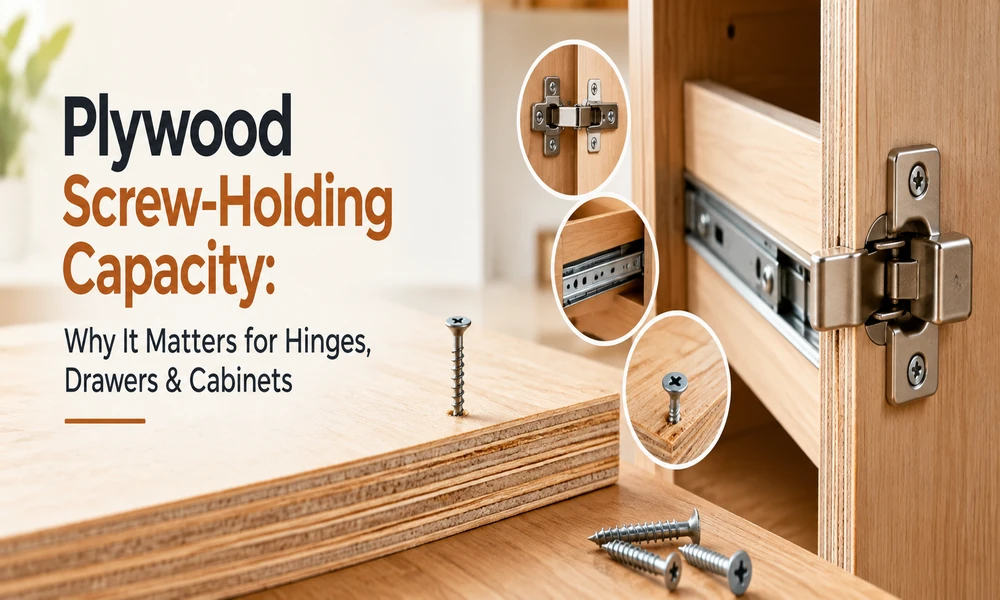
A cabinet may appear to be solid and stable once first set in place, yet issues tend to arise with the fittings months later. The door hinges start to loosen, and drawer rails get displaced, while the act of opening and shutting stresses the screw sites. The problem does not always lie within the fittings. The plywood supporting the hinge is responsible for their stability.
This is the reason why it is important to account for the screw-holding capacity of plywood while manufacturing wardrobes, kitchen cabinets, drawers, etc.
What is Screw-Holding Capacity of Plywood?
The screw-holding capacity refers to the ability of plywood to retain screws after installation. The importance of this feature is explained by the fact that many furniture pieces need screws to uphold their integrity.
Plywood is composed of multiple layers of veneer glued crosswise. Thus, as stated in the previous statement, screws can grip several layers of veneer at once, contributing to the screw retention properties of plywood.
That is why this feature becomes crucial in furniture that is assembled, taken apart, or used repeatedly.
Why Screw Holding Is Important for Hinges?
Cabinet hinges undergo movement each time the door or drawer is opened or closed. In this way, the screws keeping the hinges in their designated positions need to stay firmly in place. This can have an impact on the shutter alignment and the manner in which the door closes.
High Quality Plywood is very good for applications with major hardware due to its properties allowing screws to hold well. According to the data provided, plywood is very good for holding screws used for hanging other hardware.
The fastening of the board has to be correct too. The proper size of the screws, preparation of pilot holes, distance to the edges, and the method of installation can impact the quality of fastening.
Screw holding in any application is important. Drawers and drawer guides require proper fastening points to maintain the relative position of the whole mechanism.
Plywood is used in constructing drawers and cabinets because of its mechanical characteristics and screw-holding capabilities. The given instructions say that plywood is a good material to be applied in the construction of cabinets.
The thickness should be selected carefully. According to the recommendations given, 6mm thickness of plywood is perfect for the construction of the backs of cabinets and bottoms of drawers. 9 mm allows making cabinet doors and lighter shelving. 12 mm thickness of plywood can be used for manufacturing racks of furniture, 16 mm is necessary for building cabinets and storage systems, 19 mm is for heavy furniture, and finally 25 mm plywood is good for building very heavy constructions.
Which Plywood Exhibits Better Screw Holding Abilities?
Different kinds of plywood display different abilities of screw retention.
Gurjan and Hardwood Plywood
Gurjan plywood is said to feature a solid core and high screw-holding ability, as confirmed by the provided data, implying that it is meant for use in those instances when the furniture manufacturer calls for high functionality and lifespan.
BWP Plywood
The attribute of screw-holding property is explained by the structure of plywood, which is cross-laminated veneer plywood. It provides better screw-holding property compared to the previously discussed HDHMR in the specific data source.
Calibrated Plywood
The term calibrated refers mainly to the equality of thickness rather than to the improvement of the screw-holding property. Calibrated plywood can be defined based on the features given in the provided data, namely being sanded in such a way that its thickness is the same throughout the panel. It leads to better bonding of the laminated materials and provides smooth surfaces, modular alignment, and precise measurements.
Ways to Enhance Screw-Holding Abilities in Furniture Production
Picking a proper kind of plywood is the first step in ensuring good screw connections, but it is only part of the design process.
Consider these aspects:
- Have a proper thickness of plywood: Thin panels might be a bad option when heavy loads are carried.
- Do not choose a poor fixing location: Make sure not to get important screws too close to edge points with no support.
- Look at the core: Always check plywood for the presence of cracks prior to making furniture.
- Pick the right screws: You have to ensure the screws you use correspond to the plywood thickness and the purpose of their application.
- Fix properly: Make the installation in such a way as to avoid damaging the areas around the screw holes.
- Mind multiple usage: Hinges and drawer slides need to be chosen with the effort to make it possible to use them multiple times.
- Use plywood according to operating conditions: Choose moisture-resistant and waterproof plywood under conditions of high humidity.
Conclusion
Screw-holding property is overlooked in the process of choosing plywood type, while it plays an important role in ensuring proper functioning of furniture hardware over time. All fittings of furniture are dependent on the quality of screwing.
The combination of all suggested recommendations will result in high-quality plywood usage in the furniture construction.