
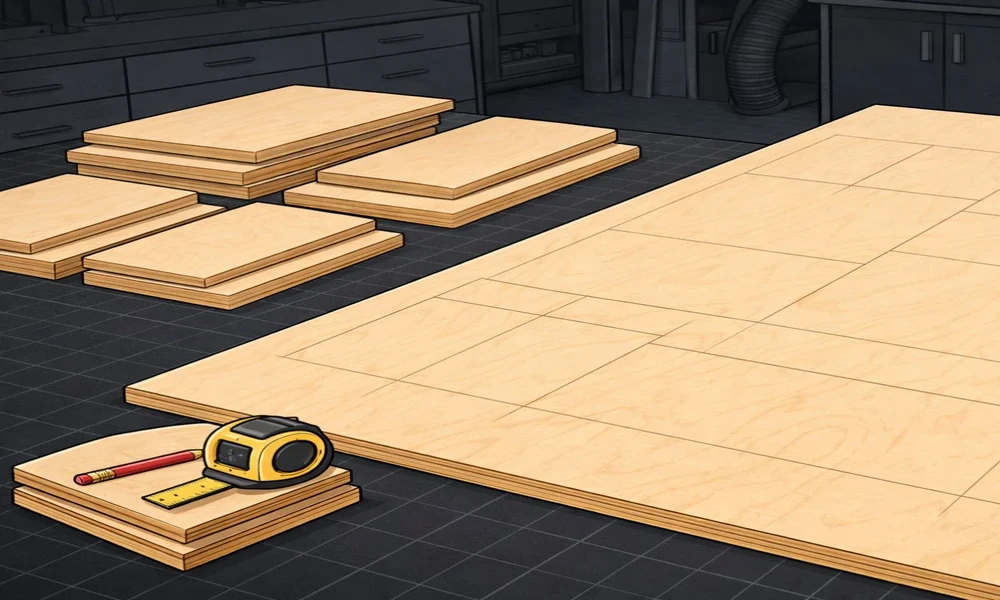
A cutting list optimization tool can make a significant difference when manufacturing or installing panels, furniture components and other sheet-based materials. Instead of relying entirely on manual calculations, a digital system can help organise dimensions, quantities and available sheet sizes before production begins. This becomes especially valuable when a project contains many different components or when material costs are high.
The basic principle is simple. A project begins with a list of required parts, including their dimensions and quantities. These parts then need to be arranged within available sheets or boards. The objective is normally to use the material as efficiently as possible while maintaining practical cutting requirements.
Manual planning can work for a small number of components, but complexity increases quickly. Consider a project with dozens of different rectangular parts. Each component may need to be produced in a particular quantity, and the available sheet material may have fixed dimensions. Rotating some pieces may improve material utilisation, but other pieces may have grain direction or finishing requirements that prevent rotation.
A cutting list optimization tool can evaluate these variables more consistently. Depending on the software, users may be able to enter different part sizes, quantities, sheet dimensions, kerf values and material constraints. The system can then generate a proposed arrangement designed to reduce unused areas.
The importance of kerf should not be underestimated. Every saw blade removes a certain amount of material during a cut. If this is ignored, theoretical layouts may not correspond to practical production. Accurate planning should therefore consider the width of the cut, particularly when many cuts are made across the same sheet.
Material orientation is another factor. Veneered boards and decorative panels may contain a visible grain or directional pattern. A component that technically fits within a sheet may still be unsuitable if it is rotated against the intended grain direction. A useful optimization process therefore needs to distinguish between simple geometric fitting and real manufacturing requirements.
Waste reduction is one of the clearest advantages. Even small improvements in sheet utilisation can become significant over a large production run. When expensive boards are involved, reducing unnecessary offcuts can directly affect the cost of a project.
A well-prepared cutting list can also improve workflow. Instead of repeatedly checking drawings and measurements at the machine, the operator can work from a structured list of components. Labels, quantities and dimensions can be organised before production starts, reducing the possibility of confusion.
This is particularly useful for custom furniture. Kitchens, wardrobes, shelving systems and built-in storage frequently contain many unique parts. A single project may involve multiple board thicknesses and materials. Separating the cutting requirements for each material can make production easier to control.
The concept also applies to architectural panels. A decorative wall may look simple from the front, but installation often requires numerous individual pieces around windows, doors, sockets and corners. Accurate planning helps determine which parts can be produced from the same sheet and where joints should be positioned.
One useful way to understand the process is through combinatorial optimization, a field of mathematics and computer science concerned with finding effective solutions among a large number of possible combinations. A cutting layout is essentially a practical optimization problem: there may be many possible arrangements, but some use the available material much more efficiently than others.
However, software should support rather than replace production knowledge. A mathematically efficient layout may not always be the easiest to manufacture. Workshop access, machine limitations, handling requirements and preferred cutting sequences may influence the final decision.
The quality of the input is equally important. Incorrect dimensions, missing quantities or an incorrect sheet size can produce an inaccurate cutting plan. Measurements should therefore be checked before they are entered into the system.
For larger projects, the benefits become even clearer. A single optimised cutting list can potentially reduce manual planning time, improve communication between design and production teams, and provide a more predictable approach to material purchasing.
There is also an environmental benefit. Better sheet utilisation means fewer discarded offcuts. Although optimization alone does not eliminate waste, systematic planning can help reduce unnecessary consumption of boards and associated manufacturing resources.
A cutting list optimization tool is therefore more than a convenience for calculating dimensions. It can become part of a broader production workflow that connects design, purchasing, manufacturing and installation. When the data is accurate and the generated layout is reviewed by someone familiar with the manufacturing process, it can help make panel-based projects more efficient, predictable and economical.